Tres Esquinas
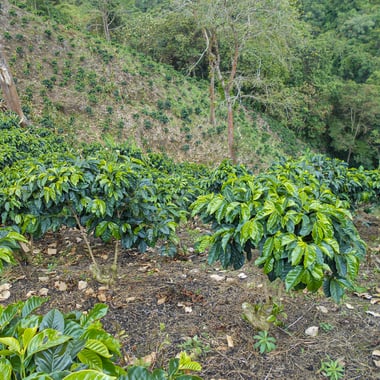
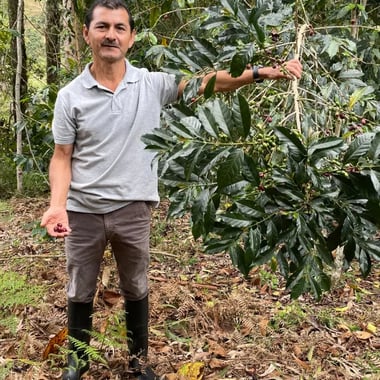
Alberizon Prada, owner of Finca Tres Esquinas, grew up with coffee. His parents were coffee growers, and he was raised in and among the coffee trees. Today, he works on his own farm with his wife, applying everything that he learned from his parents to produce specialty coffee.
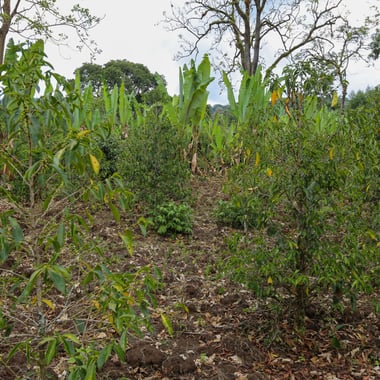
For Albeirson and his family, high quality coffee means aiming to have fewer bean defects caused by actions on his farm. He achieves this by focusing on specialized tree care, picking only mature cherries, better post harvest techniques and investing back into his farm infrastructure.
They plan to increase the quantity of available coffee, while also increasing the quality of what they harvest. He wants to start replacing his Castillo trees for Caturra because he has noticed that Caturra is more productive on his farm.
Albeirson is member of a cooperative called ASOTBILBAO, a group of dedicated producers committed to the sustainability of coffee as well as the soil in which it grows.
Processing and Fermentation
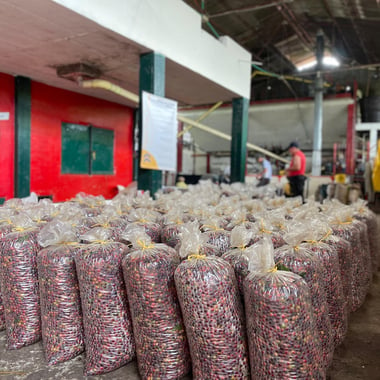
The process begins with a careful harvest, selecting only fully ripe cherries and working with trained pickers to ensure quality. After harvesting, the coffee undergoes flotation to remove impurities and defective beans. The cherries are then fermented in sealed containers for 48 hours under anaerobic conditions. After this stage, the coffee is depulped dry, passed through a screen, and placed again in anaerobic fermentation for another 48 hours. Once fermentation is complete, the coffee is washed with only two rinses. It is then pre-dried in the shade for 2–4 days before being transferred to a ventilated greenhouse dryer, where it slowly dries for about 20 days depending on the climate.